
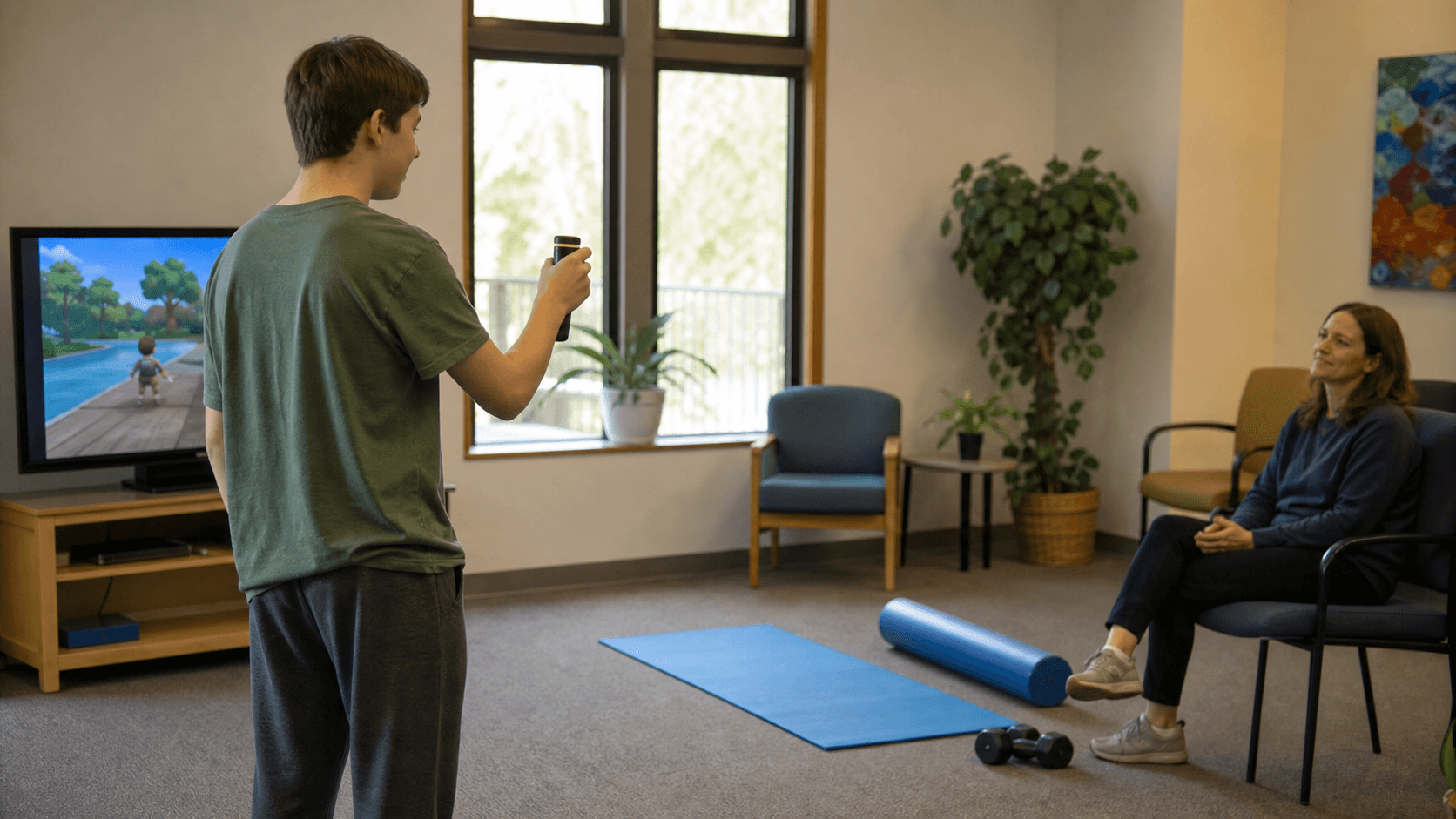
A game can be fun, tiring, noisy or all three. This review is not a reason to push a headset on anyone. It is a small clue about one kind of movement.
- Some executive-function test scores improved.
- Motor results were uncertain and varied a lot.
- Comfort and choice matter more than the technology.
Questions you can take with you
You do not need to become an expert. These questions can help you talk with a professional or support provider.
- Does this activity feel good today?
- Can we pause or stop easily?
- Would another kind of movement fit better?
Want the study details?Sample, method and evidence type
- Studies
- 15
- Young people
- 439
- Studies in meta-analysis
- 9
Read on for what was studied, what was found and what remains uncertain.
It is movement first, not magic technology
Some young people enjoy dancing games, motion sensors or a virtual walk. Others find a headset heavy, noisy or simply boring. This review looked at active VR: the kind that asks a person to move, not just watch.
It brought together 15 studies involving 439 autistic children and teenagers aged 6 to 18. Nine studies could be combined for some outcomes. The programmes, games and measures were very different.
What changed in the studies
The pooled result suggested a possible benefit on executive-function tests. The authors rated this evidence moderate, but it still comes from a small and varied set of studies.
Motor scores also looked better on average, but the studies disagreed strongly with one another. The authors rated that evidence low. For social outcomes, there were only three studies and no pooled estimate.
Keep the choice with the young person
This does not say a headset is needed for exercise, learning or support. A walk, music, swimming, a game in the garden or a quiet stretch may fit someone far better.
If a young person wants to try active VR, comfort matters: breaks, motion sickness, sound, privacy, cost and the option to stop. Those are everyday questions, not medical advice.
Limitations to keep in view
- The 15 studies used different games, schedules and outcomes; only nine could be pooled.
- The prediction interval for motor outcomes included no effect and the evidence was rated low certainty.
- The review does not show an effect on autistic traits, wellbeing, school life or long-term participation.
Effects of Virtual Reality-Based Physical Exercise Interventions on Behavioral, Executive Function, and Motor Outcomes in Children and Adolescents With Autism Spectrum Disorder: Systematic Review and Meta-Analysis
Jia Y, Qi K, Cai K, Mao Y, Guo H, Wang Q, Chen A
Journal of Medical Internet Research · 2026
This article provides general information and does not replace individualized medical, psychological or educational advice.