
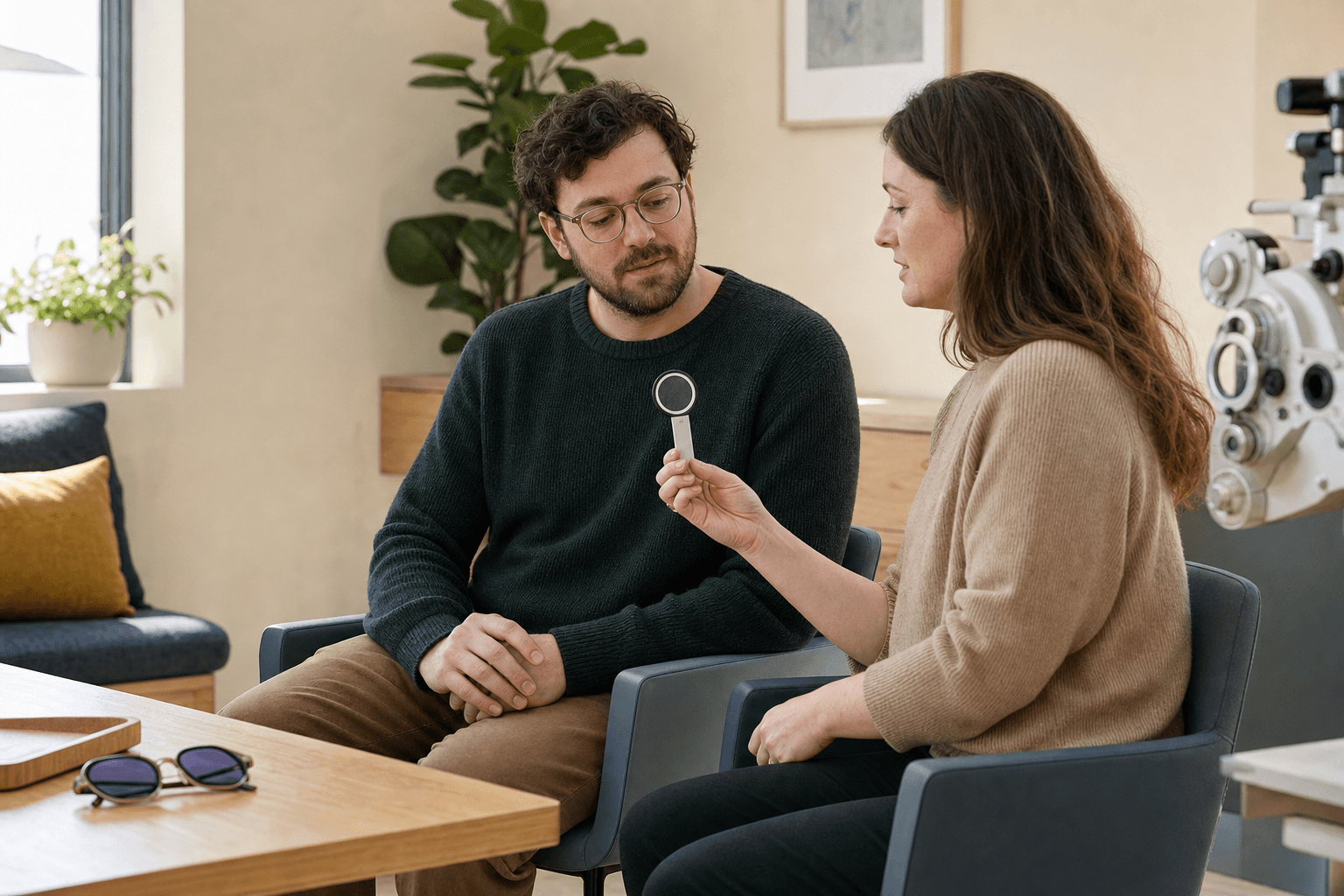
Some appointments are easy to put off. The waiting room is loud. Things move too fast. You have to explain what helps, again. Eye care can slip down the list.
- More eye conditions appeared in autistic adults’ records.
- This does not mean autism caused them.
- Accessible appointments are part of good care.
Questions you can take with you
You do not need to become an expert. These questions can help you talk with a professional or support provider.
- Can you explain the steps before the appointment?
- Could we allow more time or take a break if needed?
- What can change if bright light, drops or some tests are difficult?
Want the study details?Sample, method and evidence type
- Adults
- 5,250
- Autistic adults
- 1,050
- Any recorded eye condition
- 29.5% vs 17.8%
Read on for what was studied, what was found and what remains uncertain.
What the researchers compared
The study used electronic health records from the US National Institutes of Health All of Us Research Program. Researchers compared 1,050 autistic adults with 4,200 non-autistic adults matched on age, sex assigned at birth, race and ethnicity, and length of health-record follow-up.
At least one eye condition was recorded for 29.5% of the autistic group and 17.8% of the comparison group. Refractive or focusing problems, cataract, dry eye disease, glaucoma and strabismus were each recorded more often in the autistic group.
Recorded does not mean caused
This was an observational study. It can show a pattern, but it cannot tell us that autism caused an eye condition. The records also reflect who reached care, who was examined and what was entered into the system.
The researchers adjusted for income, education and insurance as well as the matching factors. That makes the comparison more useful. It still cannot remove every difference between the groups or predict what will happen to one person.
The part that matters in real life
The useful message is not ‘be scared’. It is that an eye appointment should be possible to get through. A quiet room, knowing what will happen before anyone starts, more time, and permission to pause can matter.
Bright lights, eye drops, unfamiliar equipment and rapid instructions can make an ordinary appointment hard. Adjustments are not special treatment. Sometimes they are simply what makes care accessible.
A careful way to use this finding
The study does not create a new screening schedule for every autistic adult. It was based on US records and cannot give an individual care plan in another health system.
If someone is worried about their vision, sore eyes, headaches, eye strain or trouble with glasses, the right next conversation is with a qualified professional who can listen to the person and adapt the visit.
Limitations to keep in view
- Health records can miss conditions or reflect unequal access to care.
- The study was observational, so it cannot establish cause and effect.
- The US All of Us cohort and health system may not represent autistic adults elsewhere.
Ophthalmic Disease Burden in Adults with Autism Spectrum Disorder
Pulukuri SV, Santra R, Rowe S, Oke I
American Journal of Ophthalmology · 2026
This article provides general information and does not replace individualized medical, psychological or educational advice.