
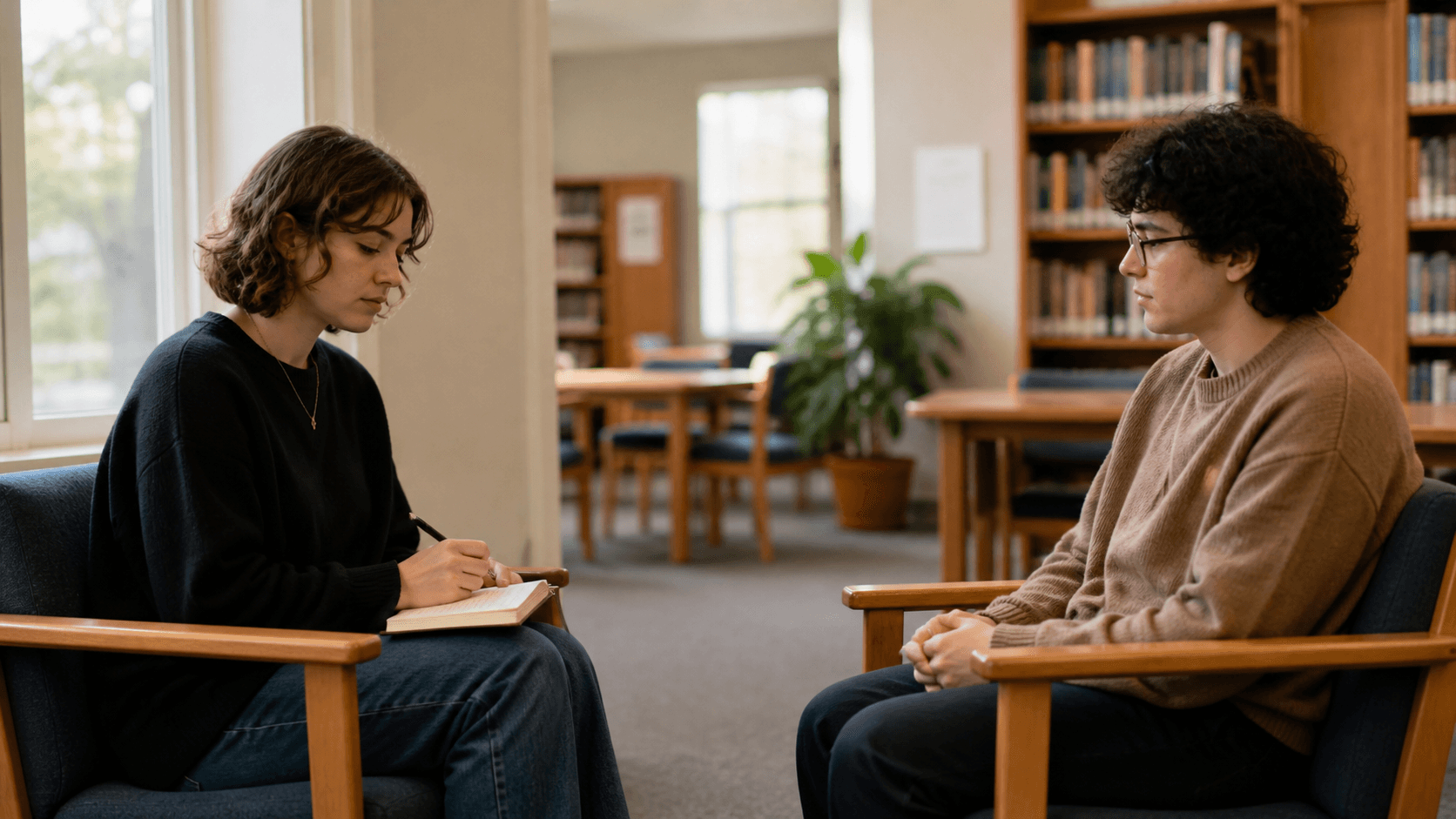
There are days when words come easily, and days when the room feels louder than the conversation. This study does not decide what anyone needs. It leaves room for people to say what helps them speak, pause or come back later.
- Noise and unfamiliar places made communication harder for many people in this group.
- A pause, a text or a quieter place may help — if the person wants it.
- These accounts describe people’s experiences. They do not explain every autistic conversation.
Questions you can take with you
You do not need to become an expert. These questions can help you talk with a professional or support provider.
- Would you rather talk here, later, in writing or not at all?
- Is there something about this place making the conversation harder?
- What would feel respectful right now?
Want the study details?Sample, method and evidence type
- People invited
- 165 autistic adults
- Written responses analysed
- 154
- Age
- 18–35 years
Read on for what was studied, what was found and what remains uncertain.
The room can change the conversation
Sometimes a conversation is hard because the topic is hard. Sometimes the room is doing part of the work: noise, bright activity, people coming and going, or the feeling that an answer is needed right now. This study asked autistic adults to look back at those ordinary moments.
Of 165 people invited, 154 written responses were analysed. Many participants said crowded, noisy or unfamiliar settings affected how they could communicate. They described losing words, relying on rehearsed phrases or stepping back from a conversation. Quiet, familiar places were often described as easier.
A pattern in one group, not a verdict about anyone
Participants also said that conversations with non-autistic people could take more conscious effort. Stress, anxiety and frustration were commonly described alongside more difficulty speaking. Feeling calm or happy was described alongside more ease. The study records people’s reflections; it does not show that one setting or feeling directly causes a particular response.
It also cannot tell us what any individual person needs. Someone may prefer a busy café, a quick spoken answer, a text message, company, silence — or something different tomorrow. The useful question is not ‘what do autistic people need?’ but ‘what works for you right now?’
Make room without taking over
There is no need to turn this into a list of rules. A pause is not necessarily a problem to solve. If a conversation feels welcome, it can help to leave time, make an offer rather than a demand, and let the other person choose how to reply.
That is not a treatment or an individual communication plan. It is a small shift in attention: the setting and the pace belong to the conversation too, and autistic people are the experts on what makes a real difference in their own lives.
Limitations to keep in view
- This is a voluntary, cross-sectional survey of 154 analysed responses from adults aged 18–35, so it cannot represent all autistic people.
- The study relies on memories and self-report; it cannot show that an environment or emotion caused a communication change.
- It did not test an adjustment, a therapy or a communication method, and it cannot prescribe what works for one person.
Navigating Mixed-Neurotype Dialogue: Environmental and Affective Influences on Autistic Speakers
Miller ZA, Conner CM, Chang JC, Mazefsky CA
Autism · 2026
This article provides general information and does not replace individualized medical, psychological or educational advice.