
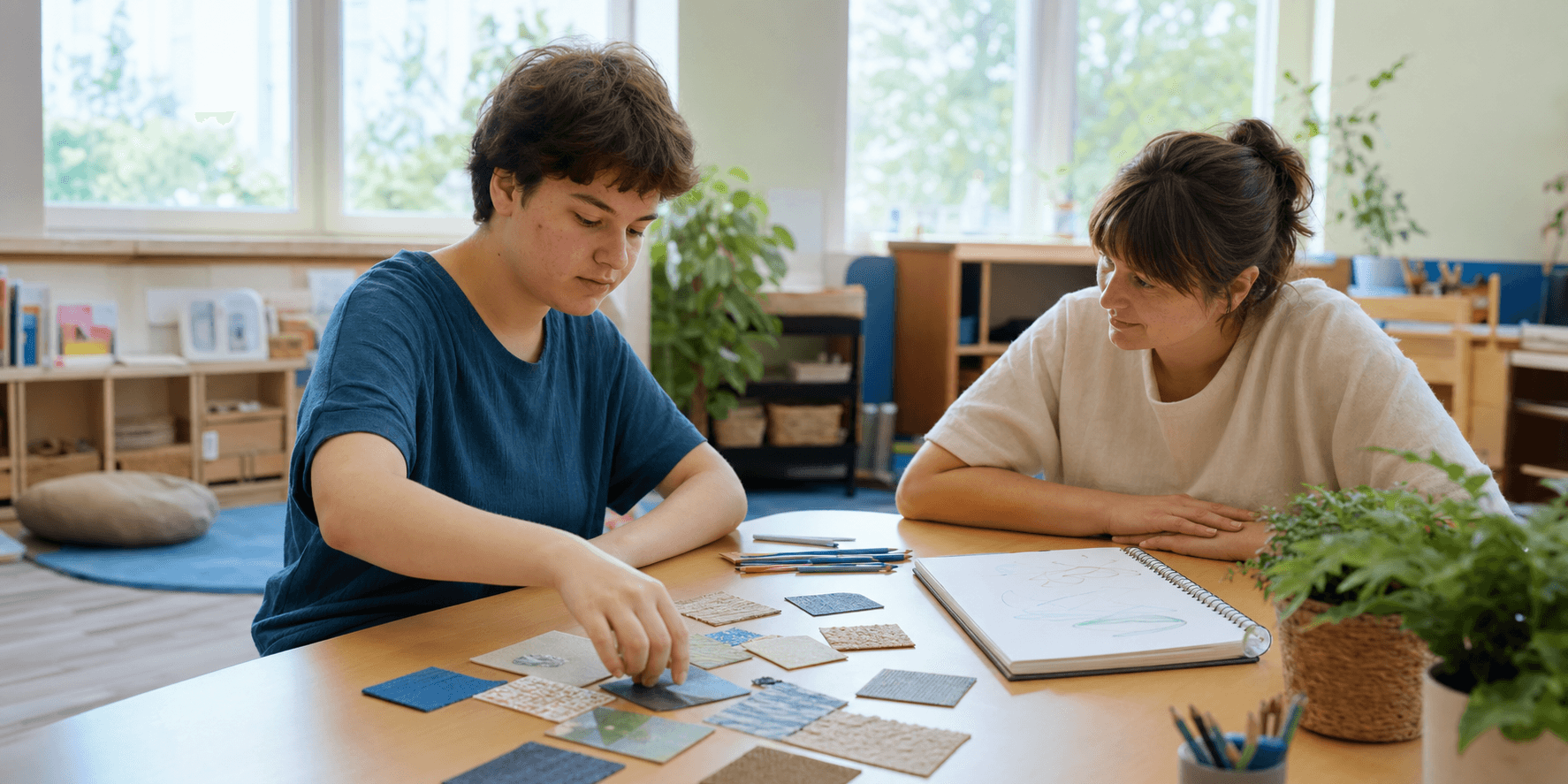
A young person can tell adults something important about school, then wonder whether it changed anything at all. This review does not offer one perfect method. It says the way we listen — and the way we come back afterwards — both matter.
- Drawing, photos and hands-on activities helped some young people take part.
- There was no single method that suited everyone.
- Few studies explained whether schools acted on what young people said.
Questions you can take with you
You do not need to become an expert. These questions can help you talk with a professional or support provider.
- Can my child choose how they share their view?
- Will someone tell them what happened after they spoke?
- Can they say no, take a break or change their mind?
Want the study details?Sample, method and evidence type
- Studies included
- 24
- Young people
- 234
- Studies from the UK
- 17
Read on for what was studied, what was found and what remains uncertain.
A voice should not disappear into a report
A child or teenager may be asked what makes school difficult, what helps, or what they would change. That can be a good start. But it can feel hollow if the answer disappears into a researcher’s notes and nothing comes back.
This review looked at 24 school-based research projects involving 234 autistic children and young people. The point was not to find a therapy. It was to see how young people had been invited to shape research about school life.
There was more than one way in
Most of the projects were qualitative, meaning they explored people’s views and experiences rather than testing a treatment. Drawing, photographs, sorting activities and making ideas together were among the approaches that seemed to help young people take part with little or no adult prompting.
That does not make a card, a picture or a creative activity a magic key. A method can feel clear and inviting to one person and awkward to another. Choice, time, sensory comfort and the chance to communicate in a preferred way still matter.
Participation was often partial
The researchers found that young people were commonly involved while a project was happening. Much less often, they helped choose the question at the start or reflect on the result at the end. Adults, including teachers, sometimes had a necessary support role. They could also influence what a young person felt able to say.
So ‘we asked the pupils’ is not the whole story. It is fair to ask: who decided the question, who was in the room, how could someone disagree, and what happened after they spoke?
A small practical shift
For families and schools, the useful idea is not a new programme to buy. It is a habit: make a real route for a young person’s view to reach the people who can act, then come back and explain what changed, what did not, and why.
That may be a short conversation, a visual choice sheet, a trusted person, a quiet meeting or a different way of giving an answer. It is not medical advice. It is a reminder that participation should be something a young person can recognise in the world around them.
Limitations to keep in view
- This review describes participatory research. It does not show that any method improves a pupil’s wellbeing, learning or school inclusion.
- The 24 studies were small and varied. Together they included 234 young people, mostly from the UK; 17.4% of participants with reported gender were female.
- The authors searched English-language peer-reviewed research from 2014 to 2024. Relevant work using other terms, languages or formats may have been missed.
- The review did not formally assess the quality or risk of bias of the included studies, so its findings should be used as careful practical clues, not a rulebook.
School-Based Participatory Research with Autistic Children and Young People: A Systematic Review of Approaches, Methods, and Outcomes
Johnson C, Wood C, Daley D, Iao L-S
Autism · 2026
This article provides general information and does not replace individualized medical, psychological or educational advice.