
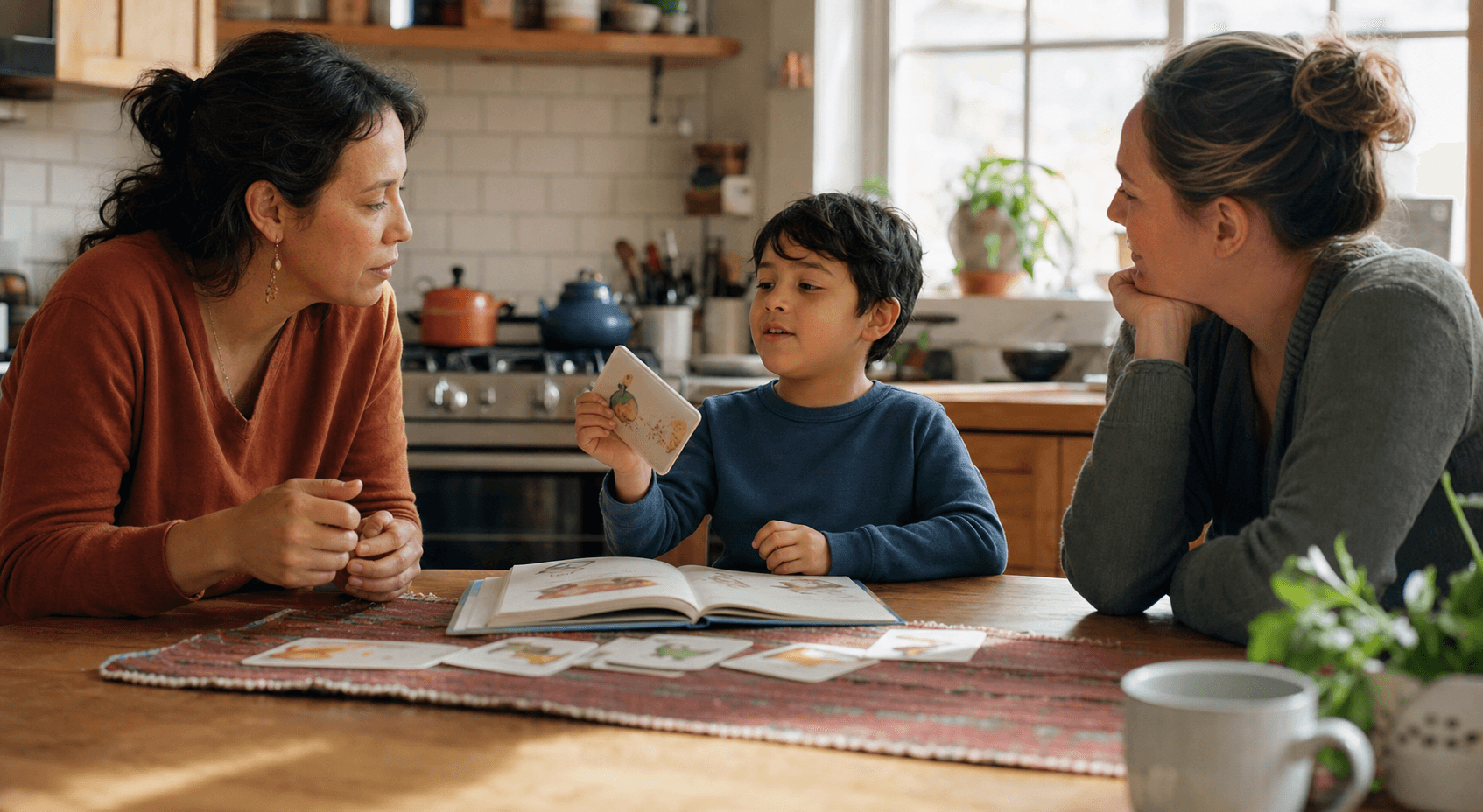
A family language can hold a lot: comfort, humour, memories and people we love. This study cannot choose a language for anyone. It simply looks at how children and caregivers kept finding each other across two of them.
- The 31 children interacted with caregivers in both languages.
- English was more dominant in this one group.
- No study can tell a family to give up a language that matters to them.
Questions you can take with you
You do not need to become an expert. These questions can help you talk with a professional or support provider.
- Which language feels warmest and easiest at home?
- How does this child show they want to join in?
- Can advice make room for our family’s own languages?
Want the study details?Sample, method and evidence type
- Children
- 31
- Languages observed
- English and Spanish
- Setting
- Caregiver interaction
Read on for what was studied, what was found and what remains uncertain.
A small, close look at real exchanges
The researchers recorded 31 minimally speaking autistic children during short English and Spanish sessions with a caregiver. They counted words, turns and the language used. This is a close observation of interaction, not a test of a language programme.
Children spoke at similar rates in the two sessions. They often followed the caregiver’s language, though English came through more often when the session was in Spanish.
What that can mean at home
There is no finding here that two languages confuse an autistic child or prevent connection. For a bilingual family, a familiar language can carry jokes, comfort, grandparents, stories and a whole way of belonging.
The study is a gentle reminder that communication is bigger than a word count. A child may answer with a look, a gesture, a picture, a familiar phrase or a mix of languages. Those are all parts of a real exchange.
What it does not settle
Thirty-one children is a small group. Everyone was observed in English and Spanish during a structured session, so the findings cannot speak for other language pairs, older children, or every communication profile.
The researchers did not test whether one language leads to better development, nor did they compare language choices over years. This paper cannot tell a family what is best for one child. A trusted professional can help with individual questions without asking a family to set aside its own language.
Limitations to keep in view
- The study observed only 31 children and one English–Spanish language pairing.
- It measured a short, semi-structured interaction rather than long-term language or wellbeing outcomes.
- It shows patterns in this group; it does not establish that one language choice causes an outcome.
Language Adaptation of Young Bilingual Autistic Children During Semi-Naturalistic Interactions With Their Caregivers
Research team published in Autism Research
Autism Research · 2026
This article provides general information and does not replace individualized medical, psychological or educational advice.