
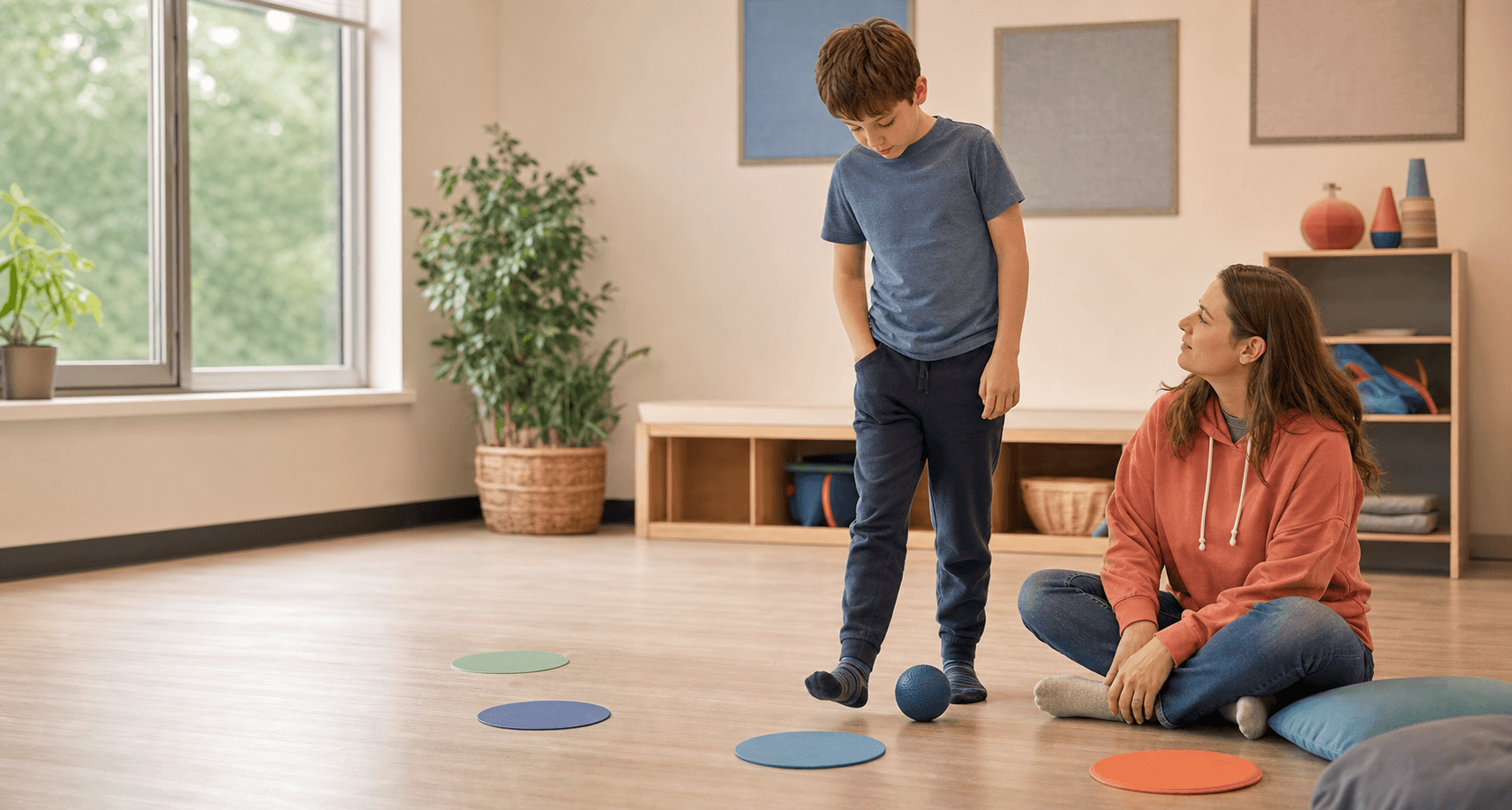
Sometimes an activity starts with hope and ends with everyone tired. This review does not ask children to try harder. It asks us to notice whether the activity itself has room for choice, breaks and real life.
- About one in four young people left an exercise programme before it ended.
- The review does not show that exercise changes autistic traits.
- A pause, a different format or stopping can all be sensible choices.
Questions you can take with you
You do not need to become an expert. These questions can help you talk with a professional or support provider.
- What would make this activity feel more manageable today?
- Can we take a break or leave early without it becoming a problem?
- Does this bring something the young person actually values?
Want the study details?Sample, method and evidence type
- Trials included
- 21
- Young people
- 565
- Estimated dropout
- 24.4%
Read on for what was studied, what was found and what remains uncertain.
A number that needs kindness
If a child stops an activity, families can be left wondering whether they should have pushed harder. This review points in a different direction. A programme can be too long, too intense, too noisy, badly timed, hard to travel to, or simply not a good fit. Leaving is information. It is not a personal failure.
The researchers gathered 21 randomized trials of exercise activities for autistic children and adolescents. Together, the studies included 565 young people. Most participants were boys, and the average ages in the studies ranged from about five to nearly thirteen.
What the review found
After the researchers adjusted for possible missing studies, they estimated that 24.4% of young people left an exercise programme before it was finished. The estimate has a wide range, from 18.1% to 32.1%, so it should not be read as an exact rule for any club, school or family.
Dropout was similar in exercise and comparison groups. That does not mean every activity was easy, or that exercise is right for every person. It only means these trials did not show more people leaving because they had been assigned to the exercise group.
The detail matters more than a label
The review found differences in dropout between kinds of activity, intensity and programme length. But it cannot tell a family which sport or class will fit their child. The studies used different activities and did not capture every reason a person might leave.
It also did not test whether staying in a programme makes someone healthier, happier or ‘less autistic’. This is not evidence for a cure, and it is not a reason to make exercise compulsory. Movement can be enjoyable, social, calming, energising, or none of those things. The person gets to have a say.
A more useful question
Instead of asking, ‘Will they stick with it?’, it can help to ask what would make this activity feel possible today. A quieter time, familiar instructor, short first visit, choice of movement, breaks, a friend, or permission to leave early can all change the experience. Those are practical possibilities, not medical advice.
A good programme notices both participation and strain. If something brings joy, confidence or connection, that matters. If it repeatedly costs too much, changing it or stopping is also a reasonable outcome.
Limitations to keep in view
- The review reports dropout, not the health or wellbeing effects of exercise and not any effect on autistic traits.
- The 21 trials used different activities, durations and measures; the reasons young people left were not consistently reported.
- Most participants were boys and the studies mostly involved children rather than older teenagers, so the findings may not fit everyone.
- A meta-analysis can summarise the trials it finds, but it cannot show that a particular programme will suit an individual child.
Dropout From Exercise Interventions in Autistic Youth: A Systematic Review and Meta-analysis
Van Damme T, Zwahlen I, de Oliveira J, Meers E, Schuch FB, Vancampfort D
Journal of Autism and Developmental Disorders · 2026
This article provides general information and does not replace individualized medical, psychological or educational advice.