
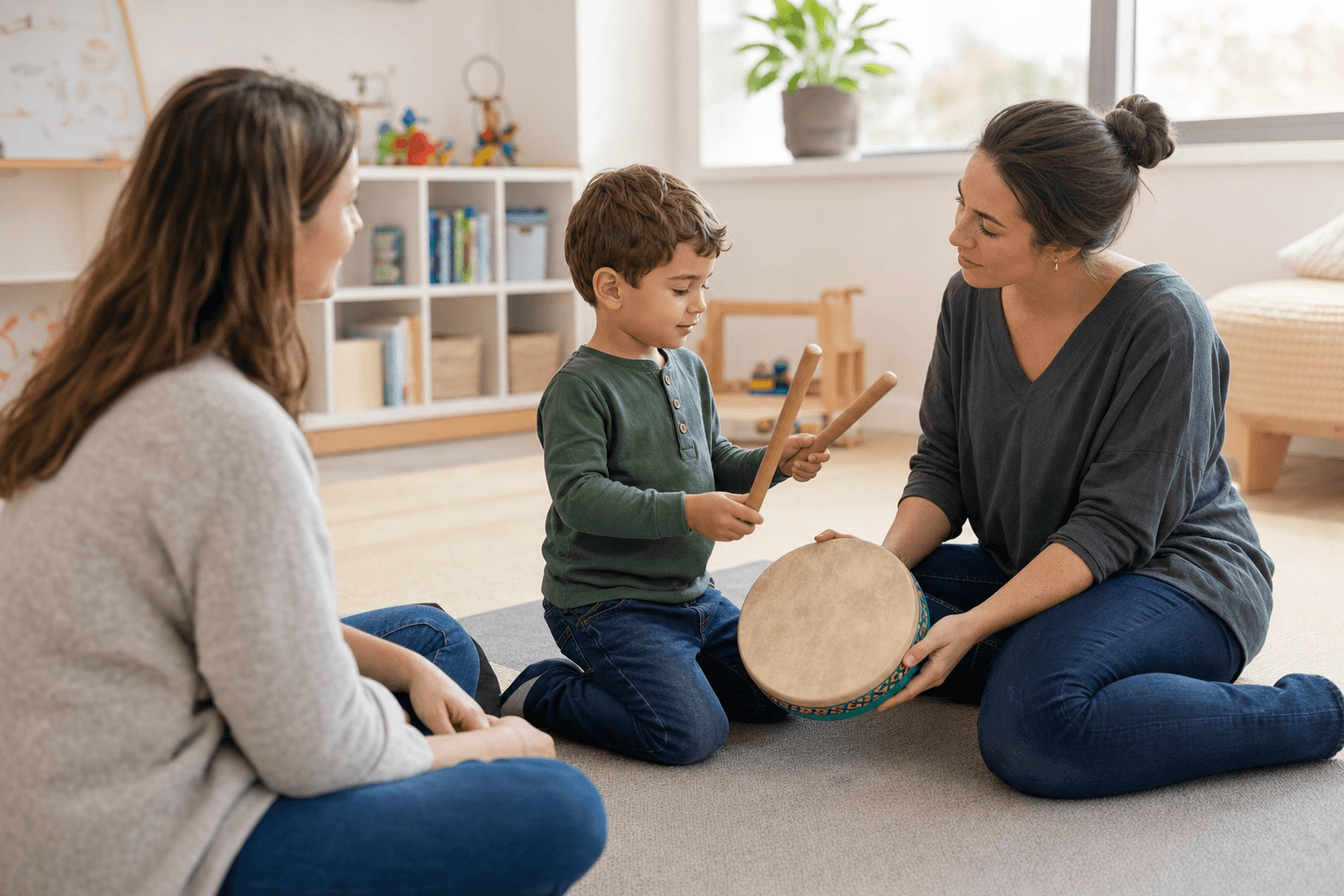
When you are trying to help your child, every new offer can feel like something you should say yes to. This small study gives permission to slow down. It does not say music is bad. It says that adding one particular programme did not improve language more than speech therapy alone, over eight weeks.
- The children in both groups made progress.
- Adding music therapy did not lead to extra language progress in this small study.
- A support can still be worth choosing when it fits your child and your family.
Questions you can take with you
You do not need to become an expert. These questions can help you talk with a professional or support provider.
- What does my child enjoy or find hard about this activity?
- What is the one goal we hope it will support?
- How will we notice if it is helping — or becoming too much?
Want the study details?Sample, method and evidence type
- Children randomized
- 40
- Age
- 3–5 years
- Study length
- 8 weeks
Read on for what was studied, what was found and what remains uncertain.
A question many families will recognise
When a child is already seeing a speech therapist, adding something else can sound like a good idea. Music can be enjoyable. It can feel social. And it can also mean one more appointment, one more cost, one more thing to fit into a very full week.
This study asked a simple question: if group music therapy is added to individual speech therapy, does language improve more than with speech therapy alone?
What the small trial found
Forty autistic children aged 3 to 5 with language delay were randomly placed in one of two groups in Taiwan. One group received group music therapy for an hour a week alongside 30 minutes of individual speech therapy. The other received speech therapy alone. The programme lasted eight weeks.
At the end, language scores had improved in both groups. But after the researchers adjusted their comparison, the music-therapy group had not improved more on the main language measure. The same was true for the other measured outcomes. No intervention-related harms were reported.
What this does — and does not — mean
This is not a verdict on music. A child may love singing, rhythm or being with other children. A family may value that time for reasons a language score cannot hold. The study simply did not find extra language benefit from this particular group programme over eight weeks.
It was also a small study. It cannot tell us which child might enjoy or benefit from a different kind of music activity, over a longer period, or with another goal. It does not support promises that music therapy will improve language or social skills for every child.
A calmer way to decide
There is no need to add an activity because it sounds impressive or because another family is doing it. It can help to ask what the child enjoys, what the actual goal is, what the week can hold, and how everyone will notice if the activity is helping or becoming tiring.
If a support already feels good and workable, this small study is not a reason to stop it. If you are choosing between options, it is a useful reminder that more therapy is not automatically better.
Limitations to keep in view
- Only 40 children took part, and 38 completed the week-eight assessment.
- The programme lasted eight weeks and tested one particular combination of services in Taiwan.
- The study did not show which children might value music for enjoyment, participation or goals beyond the measures used.
Effects of group-based music therapy combined with speech therapy on language and social skills in preschool children with autism spectrum disorder: An exploratory randomized controlled trial
Liu CE, Chen PY, Lai TJ, Yang SM
Research in Developmental Disabilities · 2026
This article provides general information and does not replace individualized medical, psychological or educational advice.