
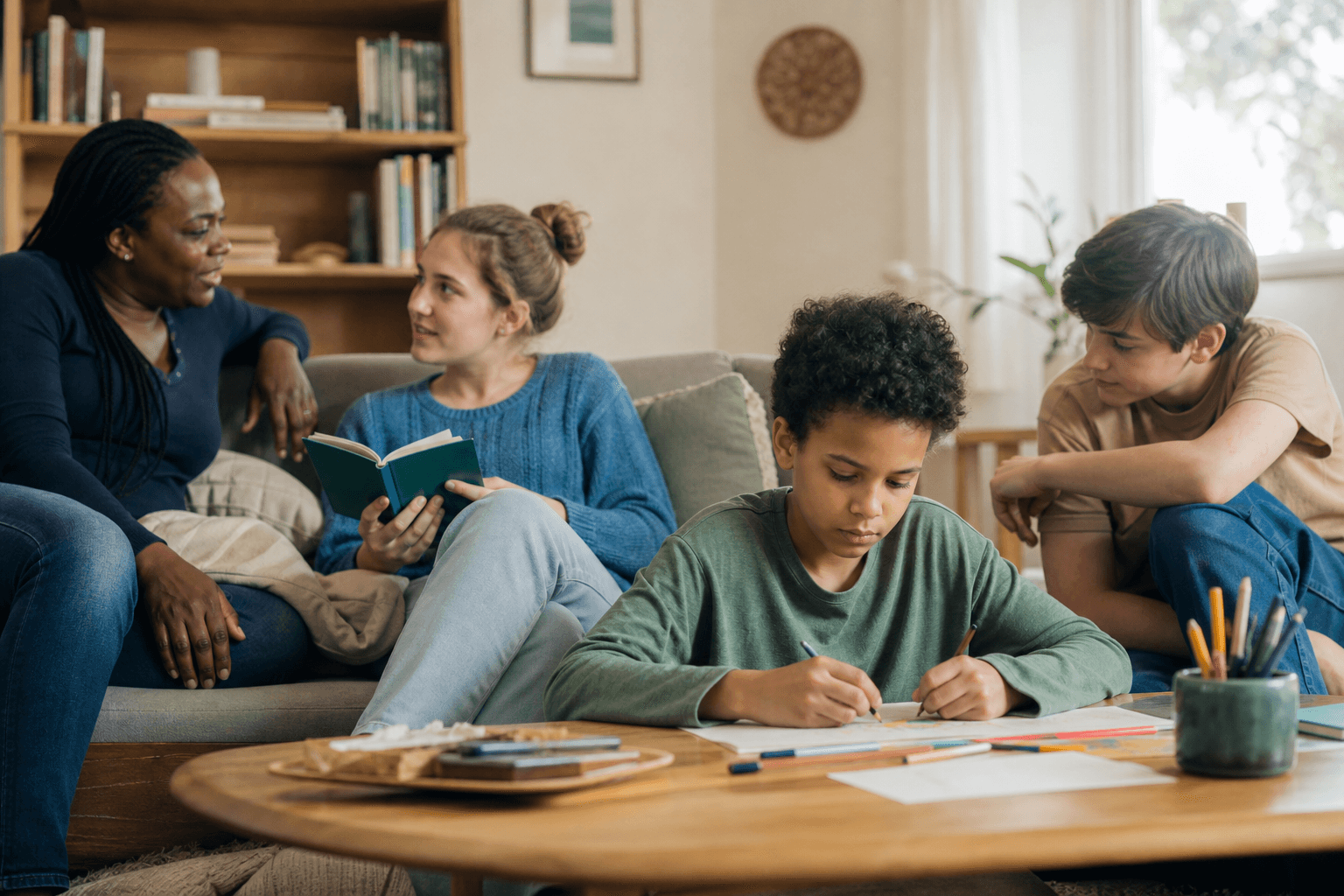
It can be easy for a sibling’s quieter questions to get lost in a busy family week. This review does not put a burden on anyone. It is a small reminder to make room for each child’s own experience.
- The review gathered 34 studies of non-autistic siblings’ own experiences.
- Love, pride, questions and harder moments could all appear in the same family.
- It does not show that one type of support works for every sibling.
Questions you can take with you
You do not need to become an expert. These questions can help you talk with a professional or support provider.
- Is there anything you wish adults understood about home this week?
- Would some one-to-one time feel good, or not especially?
- Do you ever feel expected to explain things when you would rather not?
Want the study details?Sample, method and evidence type
- Evidence
- 34 qualitative studies
- What it gathered
- Siblings’ own accounts
- What it was not
- A test of family support
Read on for what was studied, what was found and what remains uncertain.
A sibling can be fine, and still need a place to talk
A brother or sister may love the person they live with deeply. They may also have a question they do not know how to ask, or simply want ten minutes that are about something else. Those things can sit together. They do not cancel each other out.
This review brought together 34 qualitative studies about the experiences of non-autistic siblings of autistic people. It was not measuring a family’s happiness or grading anyone’s parenting. It listened for the themes that came up in siblings’ own words.
Understanding can grow in small, ordinary conversations
Across the studies, siblings often wanted a better understanding of autism, and a kinder understanding from other people too. That does not mean they should become the family expert, the translator or the extra parent. They are allowed to be a child, teenager or adult sibling with their own friendships, worries and interests.
A calm question can be enough to begin: “Is there anything you wish adults understood about home right now?” It is also okay if the answer is “no”, “not today”, or something completely unrelated to autism. Listening is not a test with a correct response.
The useful question is not whether siblings are coping
Families can notice a sibling’s experience without treating their autistic child as a problem to solve. You might make room for one-to-one time, ask what feels fair in a busy week, or check whether school situations are making things harder. The point is not to make anyone responsible for the other person’s feelings.
The review cannot tell a family exactly what to do. Most of the included research came from Europe and North America, and it did not test a particular support. Its value is more modest and more human: siblings’ lives deserve to be noticed in their own right.
Limitations to keep in view
- Qualitative studies describe experiences. They cannot tell us how common a feeling is or what causes it.
- The review only included non-autistic siblings, so it does not describe families in which more than one sibling is autistic.
- Most included studies came from Europe and North America, and the review did not test a particular sibling-support programme.
Experiences of having a sibling with autism spectrum disorder: a qualitative systematic review
Smrčková A, Kantor J, Sedláčková D, et al.
JBI Evidence Synthesis · 2026
This article provides general information and does not replace individualized medical, psychological or educational advice.