
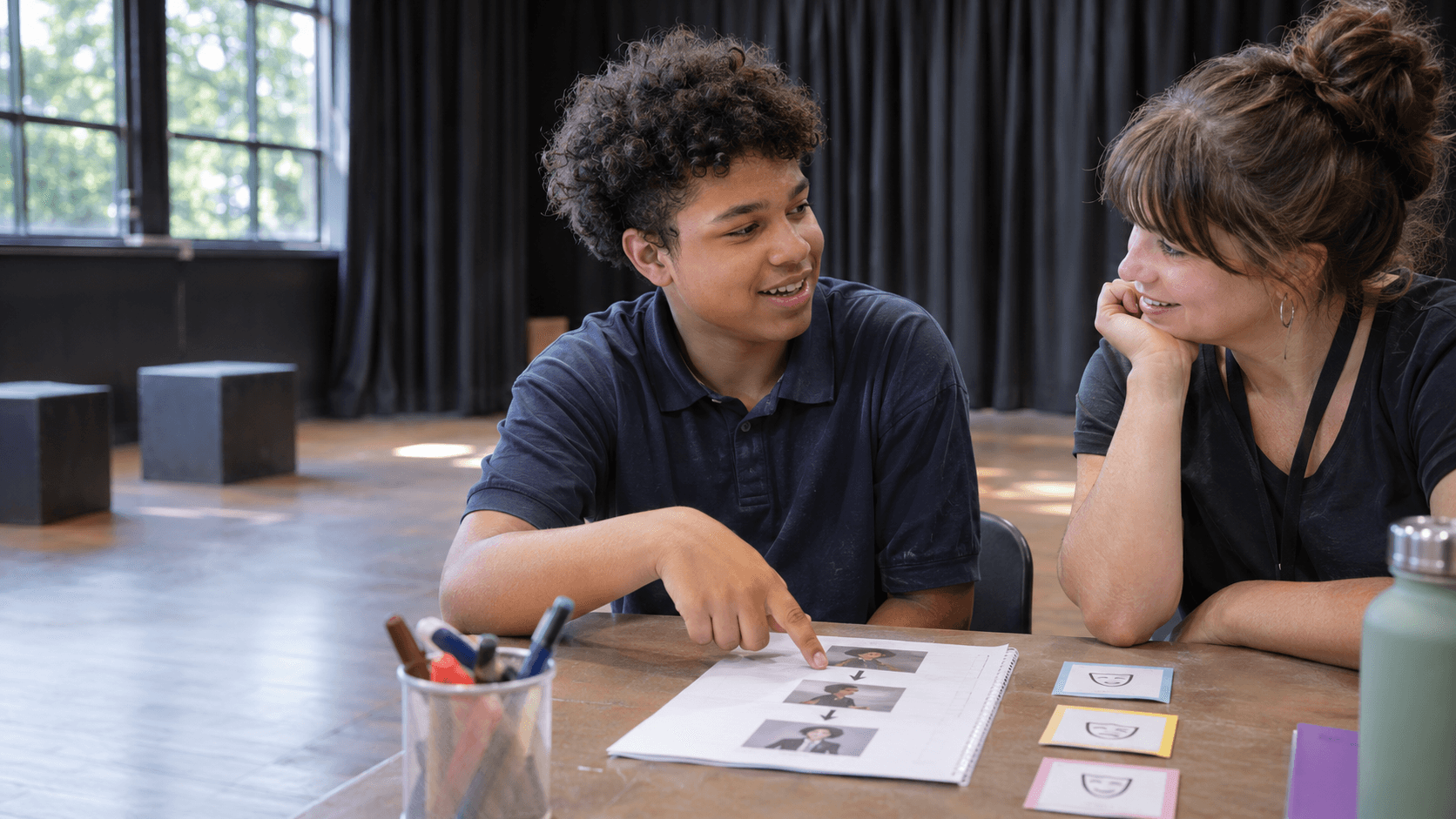
A drama lesson can begin before anyone says a line. For a young person, it may mean an unfamiliar story, quick changes, acting close to other people, a group deciding roles or an audience that feels much too near. It is reasonable to talk about the way in before they are expected to find it alone.
- The hard part may be a script, improvising, rehearsal noise, being watched, sharing roles or not knowing whether there will be a performance.
- Clear details, a written sequence and one practical role can make the next step less mysterious without promising every drama lesson will feel easy.
- A contribution offstage, time to watch first or another practical arrangement can be discussed before a young person has to prove distress in public.
Start with the part that takes the most effort
The difficult part may be a script, improvising, rehearsal noise, being watched, touching in a scene, waiting for a cue or not knowing whether there will be a performance. A young person may prefer to explain this in a note, a short meeting or with a trusted adult alongside them.
The aim is not to decide whether someone is confident enough for drama. It is to understand enough to begin one useful conversation with the adults arranging the lesson.
Make the first steps easier to picture
Adults can ask what the scene involves, how roles are chosen, whether a script is available early and what happens during rehearsal. A short written sequence, time to read the script before joining or one clear role may make the next step less mysterious. It does not promise that every drama lesson will feel easy.
It can also help to agree how changes will be shared. A written message, a brief check-in or one known adult may be more usable than a last-minute instruction in a busy room.
Keep participation practical
School may be able to discuss a different role, a contribution offstage, time to watch first, a clear place in the room or another practical arrangement that still lets the young person take part in a way that fits. The young person should not have to prove distress in front of classmates before an adult listens.
Naming who will recognise the arrangement and what happens if that person is away can keep the plan from depending on a young person finding the words again when the lesson is already demanding.
Review the lesson, not the performance
Later, ask what helped and what still cost too much. The point is not to reward eye contact, speaking volume or public performance. It is to keep one useful detail for next time and change one that did not work.
A brief answer, a note or choosing not to talk straight away can all be useful information. Adults can adjust the arrangement rather than expecting a young person to manage every drama lesson in the same way.
What this guide cannot promise
No one arrangement fits every young person, drama room or school. This is general family-planning information, not individual educational, medical or therapeutic advice.
If there is an immediate safety concern, use your local urgent or emergency route.
Questions you can take with you
To a doctor, school meeting, therapist — or simply a quiet conversation at home.
- Which part of this drama lesson takes the most effort right now?
- What details would help the young person picture the rehearsal, roles and first steps?
- Who will recognise an agreed practical arrangement?
- What should adults keep, change or review after a few lessons?
The guidance underneath this guide
Autism spectrum disorder in under 19s: support and managementNICEGeneral information, not individual medical advice. A qualified professional can help with your child’s particular situation.