
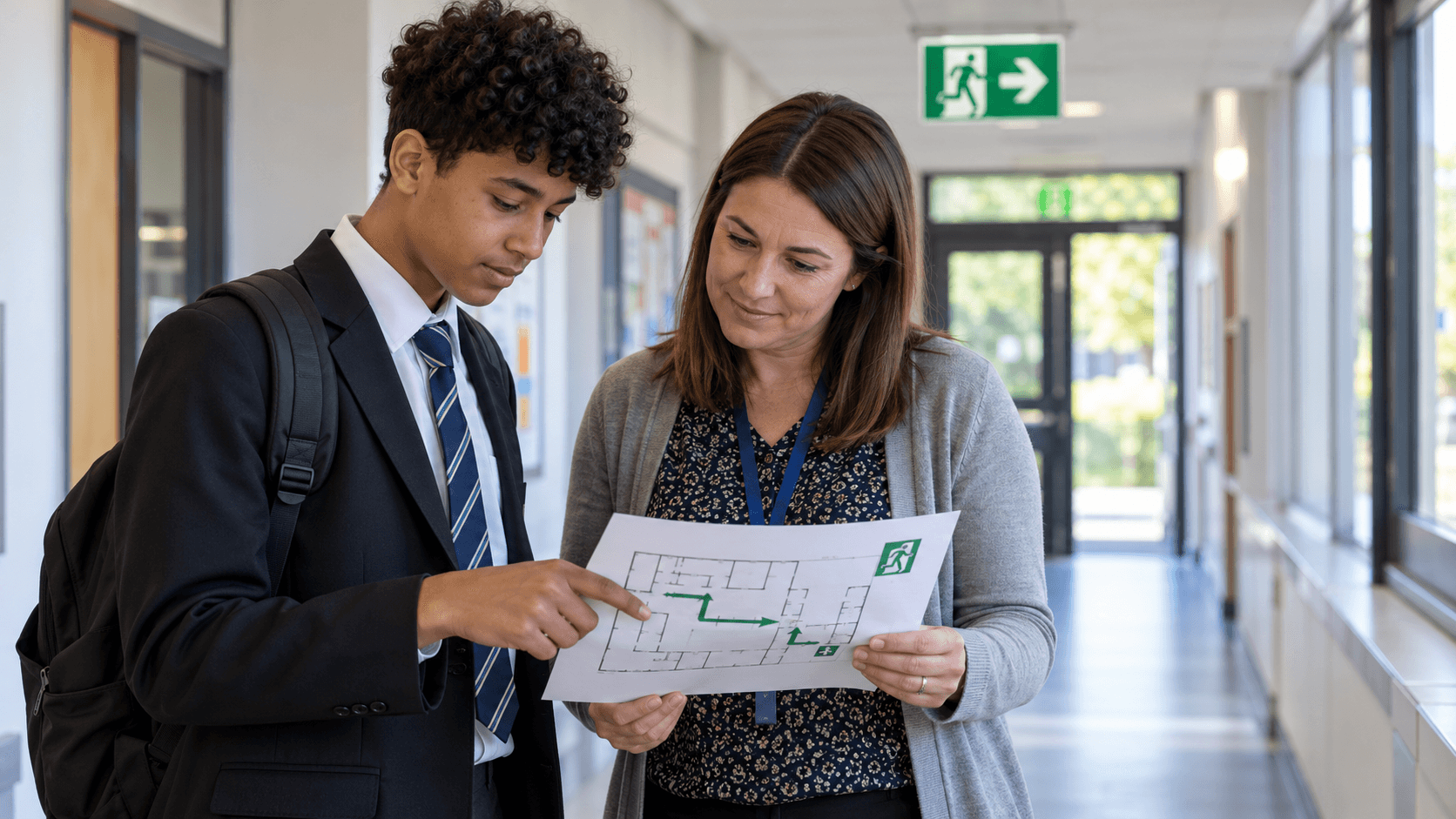
The alarm may last only a few minutes. For a young person, it can arrive as a sharp sound, a sudden change of plan, a crowded route and many adults giving instructions at once.
- Useful notice can include the time window, alarm sound, route, nearby adult and what happens afterwards.
- A quieter route where feasible, a trusted adult or a clear regrouping point can be access choices alongside safety requirements.
- Recovery can be part of the plan. It is not a reward for getting through the drill.
Share the useful details early
When school can give notice, practical details matter. The time window, the sound, the route, the adult who will be nearby and what happens afterwards can help a young person picture the drill.
The details may work best in writing, pictures or a short conversation. The point is not to make someone rehearse distress. It is to make the plan less mysterious and keep responsibility with the adults arranging it.
Keep safety and access together
A drill still has to keep people safe. School may be able to discuss a less crowded route where feasible, a trusted adult, hearing protection that does not compromise instructions, or a clear place to regroup.
A useful arrangement says where to go, who will recognise it and what happens if it stops working. It should not depend on a young person explaining private needs in front of classmates or while the alarm is already sounding.
Make recovery part of the plan
After the alarm, a young person may need quiet, water, a familiar task or a little time before returning to class. That can be information about what the setting has cost, not a reward for appearing calm.
The young person can have a say about what would help next. One option may be enough to try first, then adults can review it without treating the drill as a test of coping.
Review after a real drill
When there is time, ask what was clear, what was difficult and what could change next time. A few specific details can be more useful than asking someone to describe the whole experience.
A parent or carer can ask who will keep the plan current and how a last-minute drill will be handled. Adults remain responsible for the safety arrangement, while the young person's own view guides the conversation.
What this guide cannot promise
No plan removes every surprise or suits every school. This is general family-planning information, not individual educational, fire-safety or medical advice.
If there is an immediate safety concern, use your local urgent or emergency route.
Questions you can take with you
To a doctor, school meeting, therapist — or simply a quiet conversation at home.
- What details would help the young person picture the drill?
- Who will be nearby, and what route or regrouping point will be used?
- What could make the safety plan more accessible without compromising instructions?
- What recovery option and review point should adults agree in advance?
The guidance underneath this guide
Autism spectrum disorder in under 19s: support and managementNICEGeneral information, not individual medical advice. A qualified professional can help with your child’s particular situation.