
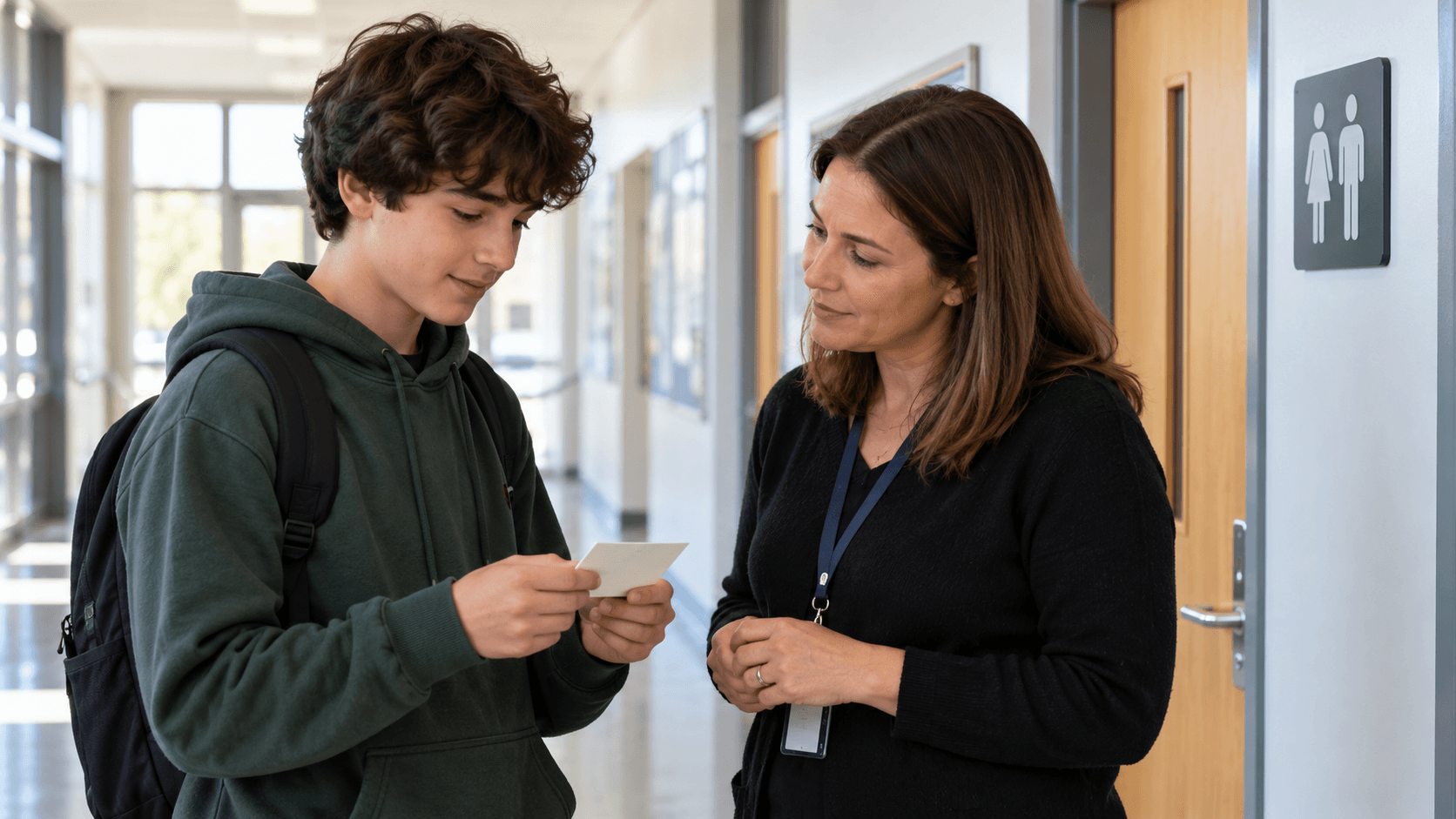
Needing the toilet at school can sound like a small part of the day. It can still mean leaving a lesson, finding a busy corridor, asking a question out loud, waiting for a cubicle, or not knowing what happens if a break takes longer than expected.
- A toilet break can be an access and dignity question, not a reward for waiting or a test of independence.
- A named adult, discreet card or agreed signal can make a private request less exposed.
- A useful plan includes the route, a return to class and a way for adults to review what still needs changing.
Start with privacy and useful detail
It can help to ask what makes the break hard to begin with. The answer may be the request, the route, the noise, the hand dryer, the queue, privacy or returning to class.
A young person may want to explain in a conversation, a note, a signal or not all at once. Their own account matters, while adults remain responsible for making the setting workable.
Agree a practical way to ask
A named adult, a discreet card or a known routine may make a request less exposed. The arrangement should be clear to the adults who need to recognise it.
A young person should not have to explain a private need repeatedly or in front of classmates. It is reasonable to ask who will know the plan and what they will do when the usual adult is away.
Keep the route usable
School may be able to talk through the route, timing, a quieter option or what happens if the usual toilet is unavailable. These are access details, not rewards for getting through a lesson without asking.
One plan may work on an ordinary day and need changing during an assembly, a timetable change or a busy break. Naming that possibility can make it easier to adjust without blame.
Make returning simpler too
The plan can include how to return to class without drawing attention. A familiar place, a short check-in or a simple way to rejoin can matter as much as leaving the room.
Afterwards, adults can ask what worked and what still needed changing. The young person's own view can guide that review, rather than asking them to prove that the arrangement was necessary.
What this guide cannot promise
No one arrangement suits every young person or school. This is general family-planning information, not individual educational, medical or toileting advice.
If there is an immediate health or safety concern, use your local urgent or emergency route.
Questions you can take with you
To a doctor, school meeting, therapist — or simply a quiet conversation at home.
- Which part of a school toilet break is hardest right now?
- Would a named adult, a discreet signal or clearer route make the request less exposed?
- What should happen if the usual toilet or adult is unavailable?
- How can the young person return to class without unwanted attention, and when will adults review the plan?
The guidance underneath this guide
Autism spectrum disorder in under 19s: support and managementNICEGeneral information, not individual medical advice. A qualified professional can help with your child’s particular situation.