
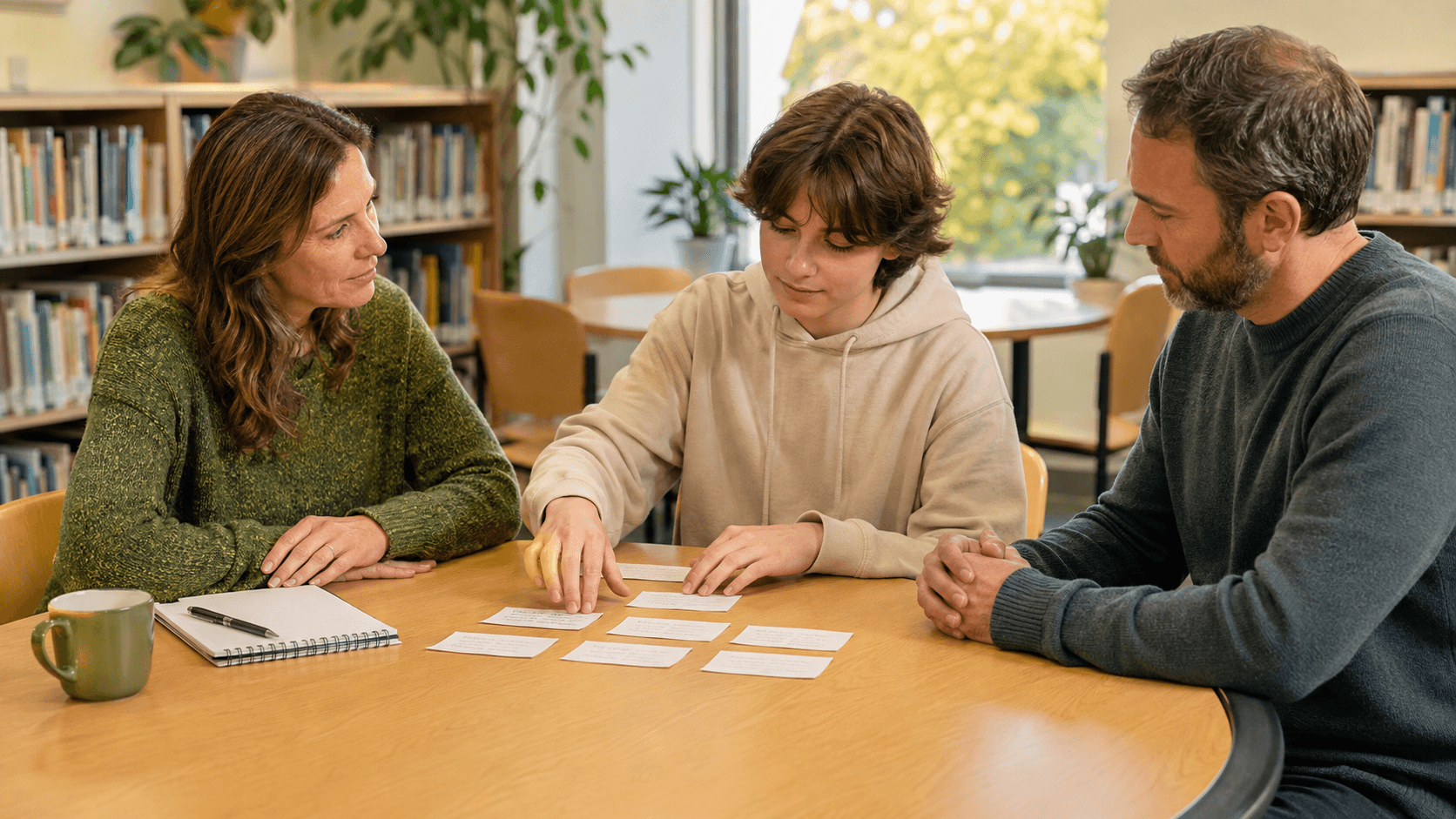
The meeting is coming up. There may be forms, reports, questions you have carried around for weeks. It is easy for the paperwork to take over. Before it does, there is one quieter place to begin: what is school like for your child right now, and what would they want the adults to understand?
- Your child's view can shape a meeting even if they do not want to speak in the room.
- One clear need, one shared responsibility and one review date can be more useful than a long wish list.
- A plan should make school more accessible, not ask a child to look less autistic.
Begin with your child's real day
A school meeting often starts with what adults think needs fixing. Try a question that is smaller and closer to everyday life: what part of the day takes the most energy? It might be getting through the gate, a crowded corridor, group work, lunch, a particular lesson, getting changed, or not knowing when plans will change.
Your child may want to answer out loud. Or they may prefer a drawing, a few notes, a scale, a familiar communication tool, or for you to bring their words into the room. They do not have to attend or perform insight for the meeting to be shaped by them. The important thing is that adults do not fill the silence with guesses when there is another way to ask.
Bring one useful example
It can help to bring one recent, ordinary example rather than a general statement that school is hard. What happened just before? What did your child seem to need? What made it worse, or helped even a little? A short example gives everyone something concrete to think about without turning your child into a problem to be analysed.
NICE asks services to consider the physical and social environment, changes in routine and the predictability of a situation when an autistic child or young person is distressed. That does not mean every difficult moment has one simple cause. It is a reminder to look at the setting, as well as at the child.
Turn the conversation into a small shared plan
A helpful plan says who will do what. For example: the teacher sends a simple message when the usual timetable will change; your child can use an agreed card or message to ask for a pause; you and the school check in after two weeks. Keep the first version small enough that it can actually happen on a busy Tuesday.
You can ask what support is realistic, who is responsible for it, and what will happen if that person is away. A good meeting is not a promise that school will suddenly feel easy. It is a chance to reduce a known barrier and to notice quickly if the plan is not doing what it was meant to do.
Keep the goal about access, not appearance
It is understandable to want your child to get through the day with less strain. But a school plan should not be built around making them seem calm, make eye contact, sit still in pain, eat in a certain way, or hide that they need a break. Those are not reliable signs that school is accessible.
A more useful question is: what would help this child take part without carrying the whole cost alone? It may be clearer instructions, more notice, a quieter route, time to process, a trusted adult, a communication option, or a different way to show learning. Your child may have their own answer. Leave room for it to change.
Set a date to listen again
The first plan is information, not a verdict. Put a review date in the diary before the meeting ends. Then ask again what helped, what did not, and whether the support was actually available when it was needed. A child may answer later, or show their answer through tiredness, avoidance or relief.
If distress is intense, new, or comes with health concerns, a school meeting is not a substitute for healthcare support. You can take both seriously: ask school to look at access, and seek appropriate professional help when health or safety needs attention.
Questions you can take with you
To a doctor, school meeting, therapist — or simply a quiet conversation at home.
- What would my child want the adults to know about an ordinary school day?
- What one situation should we understand better first?
- Who will do what, and how will my child ask for a pause or help?
- When will we check whether the plan is actually helping?
The guidance underneath this guide
Autism spectrum disorder in under 19s: support and managementNICEAutism management in children and young people: full guidelineNICEGeneral information, not individual medical advice. A qualified professional can help with your child’s particular situation.